

Keyword Search Volume Explained

Keyword search volume is one of the most important metrics that we use when creating an SEO strategy for a website. It may seem straightforward at first, since it shows you the number of times a keyword was searched for. 

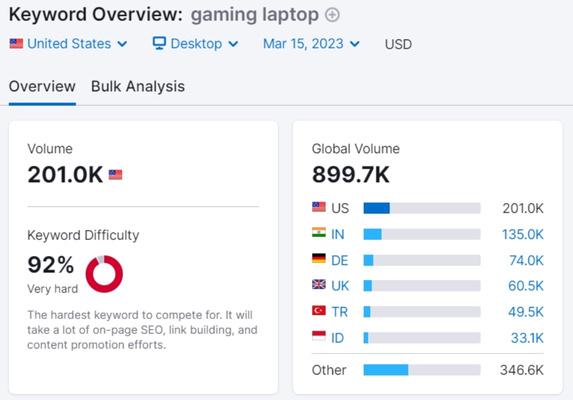
search volume of keyword in Semrush

For example, the term “gaming laptop” has 201,000 monthly searches in the US, according to Semrush. 

However, once you’ve checked the search volume, there are a few other things you need to consider alongside in order to get the full picture. 

In this guide we’ll discuss 5 mistakes you might make when interpreting the data.

Learn how to interpret the data correctly, so you can make better decisions on which keywords are worth targeting and which you may want to avoid or skip for later.


What is Keyword Search Volume?

Search volume is the number of times a given keyword or query was searched in Google. Most SEO tools show the volume as a monthly average, by taking the data from the last 12 months.

However, they also show you a breakdown of searches month by month. This way you can check for seasonality or volatility in certain times of the year.

Also, you have an option to see the search volume of a keyword for a specific country or on a global scale.

Although we’re most interested in the search volumes for Google, most SEO tools can also show you the search data for other search engines, such as: Bing, Yahoo, YouTube, Baidu, and others.

Now let’s take a closer look at 5 things you need to consider when doing keyword research and evaluating the search volume of a keyword.

1. Search volumes are annual averages

SEO tools show the average monthly search volume. They calculate the number of times a given query was searched over the past twelve months, and then divide it by 12. 

While some terms have consistent search volume over the year, there are other terms that are either seasonal or trending. To get the full picture you need to look at the data month by month for the last 1-2 years. 

If you want your website to rank for trending keywords, it may be difficult to predict how their search data will fluctuate in the upcoming months. There may be a lot of uncertainty around how they’ll perform in the future, so this is something to keep in mind when doing your content planning.

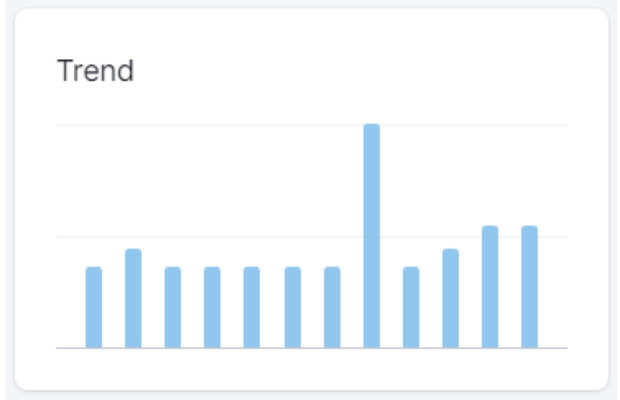
keyword search volume trend historic graph

For example, the term “iphone” has a monthly average search volume of 823,000 in the US, according to Semrush.

Looking at the search trend graph, the search volume is consistent, except for a big spike during one month of the year in 2022.

This was due to the new iPhone release on Sept. 2022, which resulted in more people searching for the term iPhone during that time.

Overall, keywords can have consistent, seasonal or trending search volume. Looking at the historical data (up to 1-2 years back), will allow us to determine this quite easily.

2. Not all search queries result in clicks

Even though people are searching for something in Google, this doesn’t mean they’ll click on any of the organic results. This is because Google has started showing the “answer” for certain queries on top of the SERP (search engine results page). 

Google wants users to find the answer to their questions very quickly and easily and for certain queries has started to show a featured snippet with the answer shown inside.

According to Semrush Sensor data, (as of March 2023) only 3.06% of Google’s first page results do not show a SERP feature. So it’s very rare to find a Google results page without any SERP features. 

google serp features in organic results

While another study conducted by SparkToro using SimilarWeb data, showed that two-thirds of Google searches in 2020 ended without a click. 

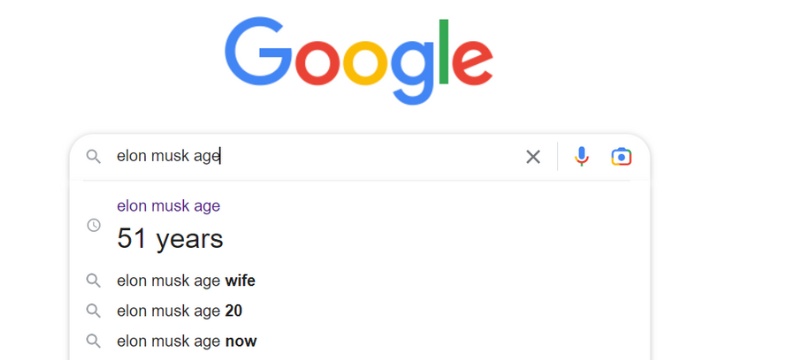
For example, when you search for “Elon Musk age” you’re given the answer right in the search bar, without you even having to press enter. 

instant answer serp feature in google search bar

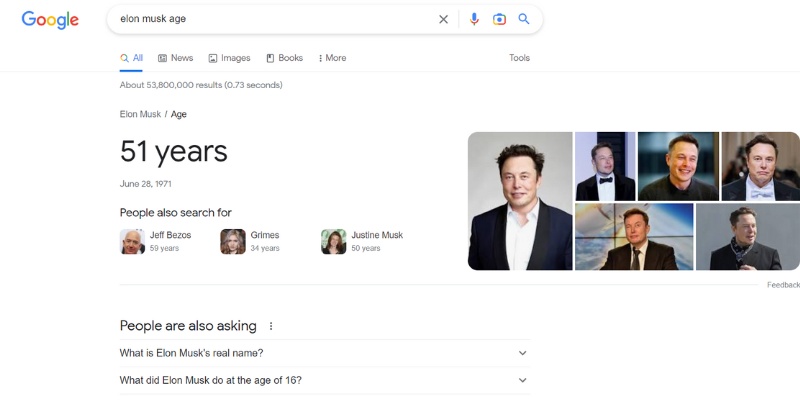
If you type “Elon Musk age” and press enter, you’re shown an “instant answer” SERP feature. Right below that there is “People also ask” questions, which also take up additional space on the SERP page, pushing the organic results further down. 

instant answer serp feature google search results

Once you know the answer, you’ll most likely close the tab or search for something else, without scrolling down the page and clicking on any of the organic results. 

This is the case for other types of searches where the answer can be shown in a “knowledge panel” or “instant answer” SERP feature. For example, when you search for: Bill Gates education, Everest temperature, chocolate calories, etc. 

At first these types of terms will show to have a high search volume. For example, “Elon Musk age” has 37K monthly search volume, however you need to also consider how many people click on the organic search results. According to Ahrefs, it turns out that only 6.3K people click on the results in the SERP. 

Therefore it’s also important to consider what type of SERP Features your keyword has, by either doing manual Google search or using a tool such as Ahrefs or Semrush. If the term has many SERP Features, such as Knowledge Panel, People Also Ask, Featured Snippet, Image Pack, AdWords, etc. then there is very little room for the organic results to be shown and get clicks from users. 

The SEO tool Ahrefs, does display this data as “Clicks”, so you want to find keywords that have high search volume but also high number of “Clicks” from users. 

In conclusion, just because a keyword has a high search volume it doesn’t mean that you’ll get lots of traffic if you rank for it on the first page of the results. 

3. Some of the clicks will go to Google Ads

Google can display as many as four ads above the organic results and three ads can show on the bottom of the page. 

Ads may have images and site links, which means that they can take up more space and push organic results further down. 

If a term has lots of ads, you’re competing both with the ads that are displayed and the other organic results on the SERP. 

To determine if a keyword is worth pursuing, check the “Search Volume”, the “Clicks” and what percentage of these clicks goes to “Paid” or “Organic” results. This type of SEO data is provided with Ahref’s Keyword Explorer tool

Ideally, you’ll want to find terms that have higher percentage of people clicking on the “Organic” results. 

4. How accurate is search volume?

This may be the most important question everyone is asking. We all use Search Volume for our SEO research, however how accurate is it really?

Many SEO professionals prefer to use Google Keyword Planner (GKP) when doing their research, since the data is provided directly from Google. In fact, many of the leading SEO tools that display search volumes use data from GKP.

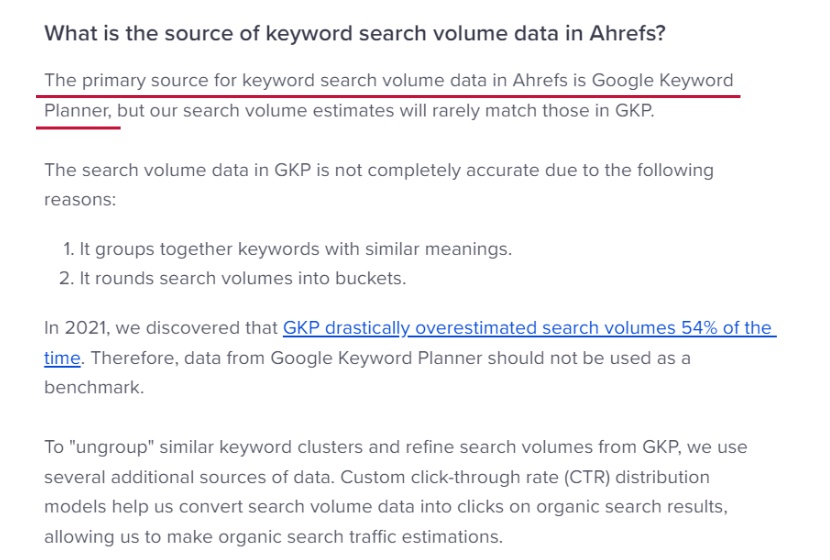
Here is an explanation from Ahrefs about where it gets its search volume data:

ahrefs keyword search volume accuracy and source

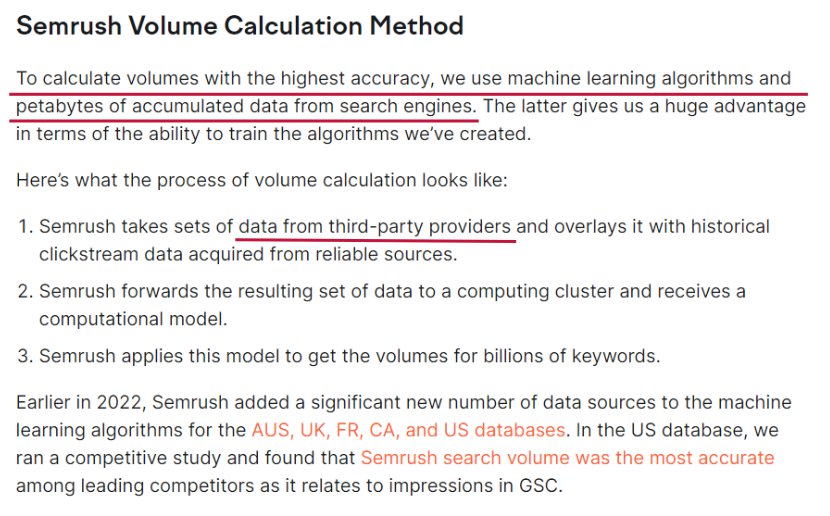
According to Semrush it calculates search volume by taking “sets of data from third-party providers and overlays it with historical clickstream data acquired from reliable sources.”

They also use machine learning algorithm, which provides more accurate volume calculation. In addition to this, Semrush has a large US keyword database which includes a total of 3.07 billion keywords.

If you use Google Keyword Planner (GKP) for your research, you’ll be able to find search volumes for keywords on a country or local level. However, you’ll need to have a Google Ads account with running ads in order to see detailed search volumes, otherwise you’ll only see averages.

GKP does have its disadvantages as well. For example a lot of keywords in certain categories are missing, due to specific policies, an example would be the medicine category.

Another disadvantage of GKP is that it aggregates volumes of search queries with similar meaning. It also groups plural versions of keywords together (ex: coffee bean, coffee beans).

5. Don’t ignore mid-low volume keywords

While we all want to rank for high volume keywords, their competition or difficulty is usually also higher. 

In some cases it may not be worth spending lots of time and resources to rank for a high volume term with high difficulty, when instead you go after mid-low search volume terms that can be easier to rank for and yield better traffic results. 

Check both the search volume and Difficulty/Competition score of a keyword and find keyword opportunities that you can rank for much faster. 

Look for long tail terms and focus on creating content for them on your website. You may want to create new product/service pages or optimize your existing ones or write more blog posts or how-to-guides. 

In the long term, our website will get more traffic for terms that are relevant to your business. 

Tip: Check our blog post on “How to find long tail keywords for your website using Quora and Reddit“.

Conclusion

Keyword search volume does seem straightforward at first, however, when creating an SEO strategy for your website you shouldn’t take this number at face value. 

Keep in mind that there are other important factors to consider such as: seasonality, number of Google Ads, what SERP features appear in the results and what percentage of people actually click on the organic results. 

Finally, also consider long tail keywords that are searched for less, but have lower competition. Chances are they will be very relevant to your business and will result in substantial traffic and sales. 

Latest from our blog

examples of successful ecommerce blogs
Examples of successful e-commerce blogs
There are several ways to increase your website traffic...

Keyword Rules Blog Imag23232es (12)
How to Optimize Your Product Pages for SEO
Every eCommerce business wants to get more organic...

google serp features explained
Guide to Google SERP Features
SERP features are elements that show on Google’s...
Ke3232yword Rules Blog Images (11)
How To Find Keywords For Your Website Using Quora And Reddit
Publishing new and engaging content on your website...

best keyword research chrome extensions seo
Top 7 Keyword Research Chrome Extensions (Free & Paid)
Discover the top 7 keyword research chrome extensions...

seo internal linking guide and tips
Internal Linking Guide: 10 Actionable Tips to Improve Your SEO
Internal Linking is probably the most overlooked and...